
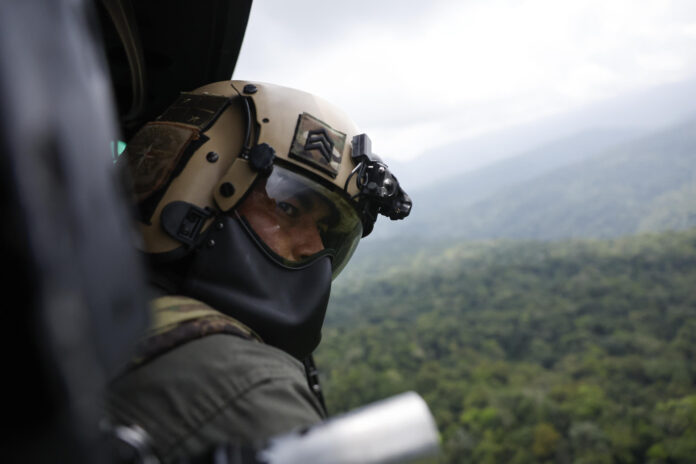
Un agente del Servicio Aeronaval de Panamá supervisa el vuelo de helicópteros en selva del Darién línea fronteriza entre Panamá y Colombia, Alto Limón (Panamá). EFE/ Bienvenido Velasco
Tensions remain high across the dense jungle separating South and Central America. Consequently, security forces are launching targeted Darien Gap security operations along the 266-kilometer boundary. Panamanian police and Colombian anti-narcotics units coordinate closely to dismantle illegal networks. This unified joint counter-narcotics mission seeks to curb illicit trafficking while maintaining sovereignty in remote territories.
Tactical Eradication at the Alto Limon Binational Post
Operating near the Alto Limon binational post, military and police teams face severe logistical challenges. Approximately 500 hectares of illegal crops blanket the surrounding Colombian territory. Black Hawk helicopters transport specialized teams to carry out coca crop eradication using glyphosate sprays. Because hostile groups often ambush field crews, Panamanian agents provide vital perimeter protection.
This collaborative effort highlights the strength of Panama Colombia border security. Currently, nineteen officers share duties at this key border outpost. While Colombian technicians perform illegal crop destruction, Panamanian border guards maintain defensive positions. As a result, field teams execute complex missions safely within dense rainforest conditions.
Countering the Influence of the Clan del Golfo Cartel
The primary objective of these joint tactical maneuvers involves neutralizing the Clan del Golfo cartel. As Colombia’s largest criminal network, this syndicate controls illegal drug movements, migrant smuggling, and extortion across the border corridor. Authorities emphasize that no illicit business occurs in the region without the explicit approval of this powerful armed drug cartel.
Therefore, preventing criminal spillover into Central America remains a national priority. Officials expect organized groups to seek new transit routes following political shifts and law enforcement pressures in Colombia. To counter this risk, Panamanian border service Senafront deployed over 700 special forces personnel to key strategic zones.
Strengthening Cross-Border Police Cooperation
Long-term success relies on maintaining a continuous presence along the frontier. Three official binational posts and four intermediate operational bases now form a comprehensive protective shield across the region. Furthermore, this network allows security forces to deter criminal movements before syndicates cross into Panamanian soil.
Although Panama abolished its regular military decades ago, specialized public forces maintain rigorous Darien jungle law enforcement standards. Through ongoing cross-border police cooperation, both nations reinforce regional stability. Consequently, these continuous patrols ensure that the Panama Colombia border security framework remains an effective deterrent against organized crime.