
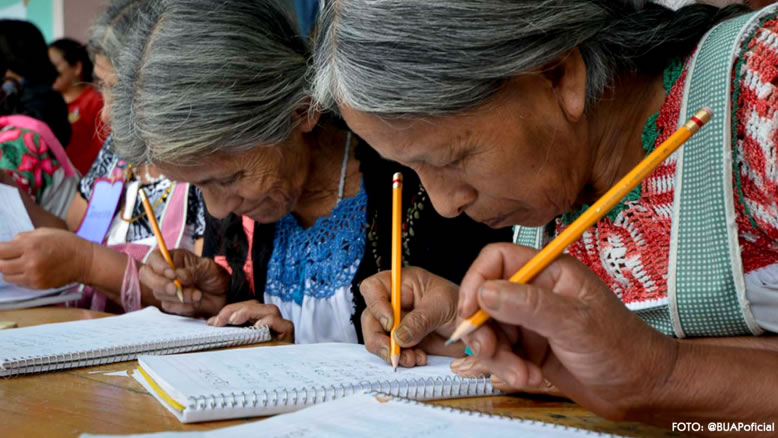
Escarreola added that during the current administration they managed to alphabetize, until last August, approximately three thousand 238 persons in 10 provinces and three regions of the country, which in his big majority continue the primary studies in the programs of young people and adults of the Department of Education.
Up to now, the program is provided with 198 volunteers in the whole national territory and 217 areas of meeting in functioning, equipped with a TV set, DVD, board, draft, chalk and a set of classes in CD, sufficient hardware to teach to read and to write, across a method that combines the numbers and the lettering.
In accordance with Estrella Sosa, methodological assessor of ‘ I yes can ‘, the program manages to link the numbers to the daily tasks, which facilitates ‘ to teach to count ‘, hence at the end of two months the person learns to read and to write, product of the link of the numbers with the lettering.
Nevertheless, he clarified that exceptions exist, since the age or the visual problems can slow down learning.
Information of the Census of Population and Housing of the General Controller’s office of the Republic reveal that in 2000, Panama was provided with 168 thousand 140 illiterate persons, number that in 2010 limited to 148 thousand 747, which there represent 5,5 per cent of the entire population of this moment.
Quantity that does not allow him to the country to be declared free of uncultured, since to reach this category, the illiterate population must be below five per cent, according to the United Nations Organization for the Education, the Science and the Culture (UNESCO).
Created by the teacher and investigative Cuban Leonela Relys, from his restoration in 2002, the method of literacy I yes can, he has benefited 9,8 million persons in different languages and languages indigenous to an about thirty of countries.
For his excellent results, the program there received the 2006 Award for Literacy King Sejong of the UNESCO, granted to the Pedagogic Latin-American Institute and of the Caribbean, to Cuba.
If the population were not required to purchase their own uniforms to go to school it would help. If the population did not have to pay for their own transportation to school in order to go to school, this would help. If the kids were not forced to help with the crops and work on the farm instead of going to school, this would help. And finally, if the teachers were trained better and cared whether the kids learned or not that would help too. Some are very good teachers and some are awful. This is a universal problem. It is a problem caused by low pay for teachers, and by people who do not see the value in a good education. Children are the future and your legacy. Family is very important in Panama. We must educate the population on the importance of a good education so that they demand better schools and provide the money necessary to make it happen. Don’t let the schools become indoctrination sites as in the states. Teachers should be trained and respected but not unionized with bad teachers protected.