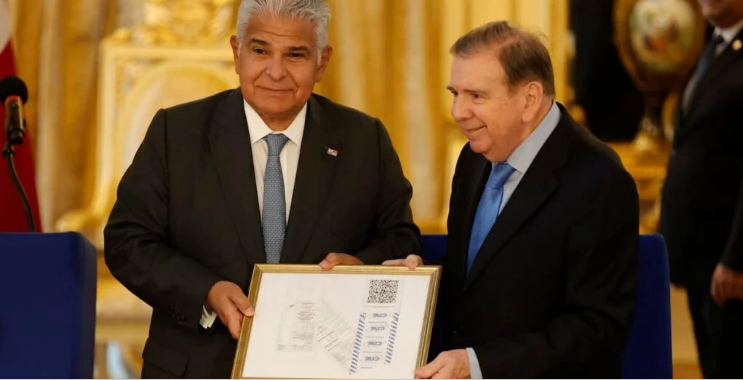
A transcendental political document is emerging at an crucial hour to redefine the future of Latin America. Driven by a powerful citizen mandate, this historic consensus builds directly upon the presidential election where Edmundo González Urrutia secured a victory. Under the strategic María Corina Machado leadership, democratic actors are stepping forward to operate as the legitimate architects of a full restoration of freedom.
Consequently, political analysts look closely at this agreement to comprehend how it differs from traditional compacts. To fully grasp the Panama Manifesto Significance, we must evaluate its historical depth, its inclusive social nature, and the geopolitical alliances that validate its future implementation.
Historical Foundations: Beyond the Pacto de Puntofijo Comparison
To understand this new political framework, observers inevitably establish a Pacto de Puntofijo comparison. In 1958, that legendary agreement successfully consolidated a civilized republic dominated by traditional political parties. It established a structural commitment to preserve constitutional rules and respect transparent election outcomes.
However, the current Panama Declaration Meaning goes much deeper than its mid-twentieth-century predecessor. While the old pact sought a minimum common platform among professional politicians, the modern agreement aims to rebuild the very fabric of the nation. Therefore, this Puntofijo agreement analogy proves that while past pacts stabilized institutions, today’s priority centers on translating popular sovereignty into a structured, irreversible road toward true liberation.
A Comprehensive Framework: The Gran Acuerdo Nacional
In contrast to older strategies, this initiative introduces the foundational basis for a Venezuela democratic transition. This movement materializes through a comprehensive project known as the Gran Acuerdo Nacional. This collective effort does not belong to a closed group of elite political organizations. On the contrary, it includes labor unions, religious institutions, academic sectors, and the massive diaspora living abroad.
Through this Great National Agreement, the opposition establishes a cohesive strategy to face an agonizing authoritarian regime. The unity described in the text functions not as a temporary rhetorical slogan, but as a practical tool for systematic action. As a result, this vast social alignment guarantees that the upcoming Venezuelan democratic change will possess the institutional durability that previous transitions unfortunately lacked.
Strategic Direction: Under María Corina Machado Leadership
The implementation of these structural objectives requires exceptional coordination, which explains the centrality of the María Corina Machado leadership. Over the past decades, traditional caudillismos and military interventions frequently disrupted civilian progress. Conversely, this current dynamic transcends conventional partisan boundaries.
The legitimization of her Machado political guidance stems directly from public trust and popular consensus. This coordination ensures that all democratic movements walk alongside the citizenry rather than trying to dictate rules from above. Accordingly, her guiding role transforms the political struggle from a mere electoral race into an enduring state of civic spirit.
Geopolitical Realities and the Key Role of Panama
Finally, the geographical choice for this consensus carries immense historical symbolism. Historically, Francisco de Miranda recognized the Isthmus of Panama as the literal gateway to the continent and the heart of an emerging free hemisphere. In 2026, this location proves vital once again, as local authorities have firmly guarded the authentic electoral evidence and original voting records.
Supported by essential international support, this strategic platform provides the geopolitical leverage necessary to enforce governance. The Panama Manifesto Significance lies in its capacity to balance global trade interests with the defense of institutional freedom, providing a realistic blueprint to restore long-term democratic stability in the American continent.