
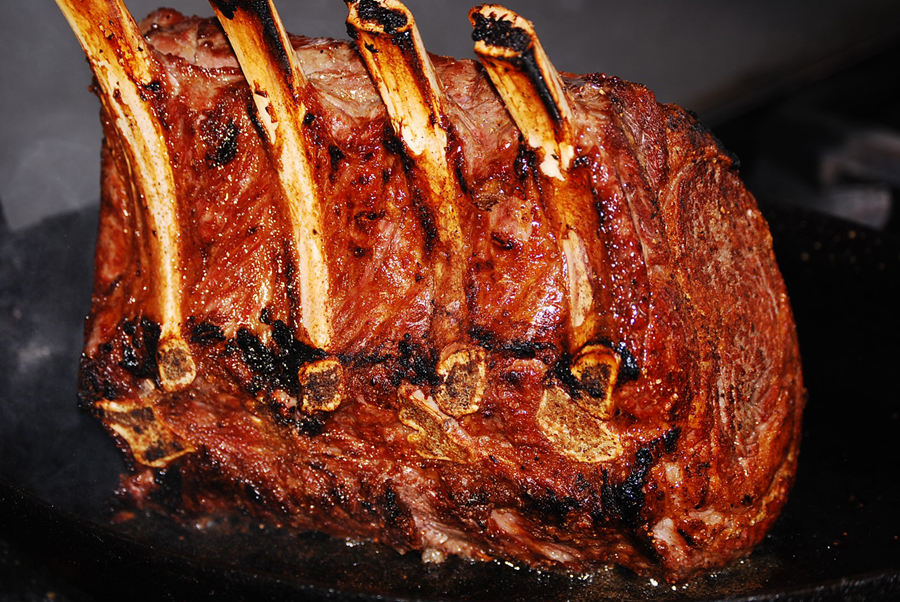
Sorry if I offend any vegans but UMMM, I cannot wait for the prime cuts of beef to show up in Panama with the lifting of the high duty that was once charged. While regular cuts still will have a 30% duty, the better cuts will drop to 0%.
The U.S.-Panama Trade Agreement took effect Oct. 31, further enhancing market access for U.S. beef in Central America. The agreement grants immediate, duty-free access for high-quality (Choice and Prime) beef cuts. All other beef muscle cuts are subject to a 30% duty, but this rate will be phased down to zero over the next 15 years. For beef variety meat, Panama’s 15% duty fell to zero immediately for some items, while the duty rate for others will be phased down to zero over the next five years.
The U.S. Meat Export Federation (USMEF) projects these market-access improvements will help boost beef exports to Panama to about $8.5 million in 2013, which is a sizeable increase. Exports to Panama totaled $5.2 million in 2011, but should easily surpass that figure in 2012. Even with pre-FTA duty rates in effect, exports had already reached $4.9 million through the end of September and should finish the year near $7 million. This makes Panama the 33rd largest market for U.S. beef in terms of value. At 1.33 million lbs., it is the 39th largest volume destination.
“We were ready to hit the ground running in Panama, thanks to behind-the-scenes groundwork done in anticipation of the trade agreement,” explains Gerardo Rodriguez, USMEF director of trade development for Central America and the Dominican Republic. “This included early identification of potential marketing opportunities and beneficial partnerships with importers and retailers. USMEF has been working on the educational aspects of our marketing strategy for some time in Panama, so that when the FTA took effect we could fully capitalize on this opportunity.”
In July 2011, USMEF chose Panama City as the venue for its first major product showcase in Central America. The two-day program attracted more than 75 buyers from Panama, Guatemala, Belize, El Salvador, Costa Rica, Nicaragua, Honduras, Columbia, Chile, Peru and the Dominican Republic, introducing them to high-quality U.S. meat products. The turnout of U.S. exporters was also outstanding, as they sought to gain an early foothold in a market where trade barriers would soon be lowered.
“Our main goals of the product showcase were to give USMEF members a chance to see the market firsthand, allow them to meet face-to-face with importers and educate them about the rapidly growing opportunities in the region,” Rodriguez says.
A Closer Look: Central/South America Targets Of Beef Export Growth
Rodriguez notes that U.S. beef exports have been achieving success in Central America for some time thanks to CAFTA-DR, the Dominican Republic/Central America Free Trade Agreement that was implemented several years ago (Panama was the only Central American country not included in CAFTA-DR). He says CAFTA-DR has been especially beneficial in developing a strong market in Guatemala, which is now a Top 20 destination for U.S. beef in terms of both volume and value. Through September, beef exports to Guatemala had reached 6.6 million lbs., valued at $15.1 million. This is an increase of 27% in volume and 38% in value over the record pace of 2011.
USMEF works with some Guatemalan importers who have branch operations in El Salvador, and they are now helping expand the presence of U.S. beef there as well. This year’s exports (through September) to El Salvador are up 11% in volume (227,076 lbs.) and 42% in value ($1.1 million) compared to last year.
In Honduras, exports are 8% higher in volume (1.56 million lbs.) compared to a year ago, and have surged 46% in value to $3.1 million. Another promising market is Costa Rica, where volume is down slightly but export value has increased 16% to nearly $3 million.
“With duty rates being ratcheted down and other trade barriers also lowered, CAFTA-DR has really opened new doors for U.S. beef in Central America,” Rodriguez says. “That experience is one of the reasons we are so excited about the Panama FTA.”

This is NOT good news for Panamanian’s health. US food might be cheap but the cost is quality-it’s horrible.
The chemical and big food companies have hijacked US agriculture. There are so many concerns- from GMO altered genes transferring up the food chain to people, to filthy animal feedlots, to foods laced with pesticides, herbicides, and antibiotics, to lax or non-existent regulations, it’s hard to know what to eat unless you know the farmer or grow it yourself, I’m afraid.
Let the buyer beware.
Unfortunately, the Prime beef from the US is almost 100% sure to be loaded with fat, hormones and antibiotics to raise your resistance to antibiotics when you most need them. II NEVER buy beef from the US for those reasons.
AND, and have grown to love the REAL beef flavor of the Panamanian beef. Yes, it may be tougher, but wrapping it in papaya peels and puncturing it all over to get the papain into the flesh perfectly tenderizes it. That is the effective ingredient in commercial meat tenderizers.
Save your health and pocketbook: eat local.