My friend Kent Davis at Panama Equity wrote a great piece on real estate in Panama City and he has the best researched data on current market pricing.
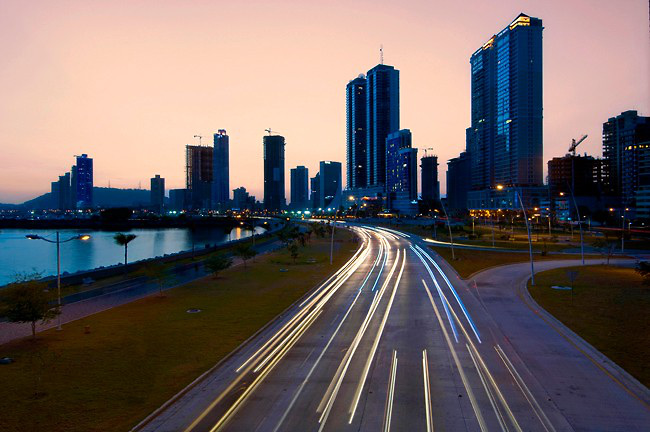
Prices at Panama City’s Balboa Avenue have remained stable during 2012, and there are no signs of a real estate bubble. A further drop in Panama real estate prices along Balboa Avenue has not materialized in 2012 and there are strong indications that a major correction in residential real estate prices in Panama will not arrive anytime soon. Over 90% of the new residential towers along Balboa Avenue are now complete, with almost 30% of that new inventory coming on line in the last 12 months, yet prices have come down by less than 2%.
The Panama real estate market has dodged another bullet, with any perceived excess supply having very little impact on pricing. Demand is being supported by a strong local economy, banks flush with cash, government sponsored infrastructure improvements, and foreigners and multinational corporations continuing to relocate and invest.
Prices are at their lowest levels in over four years and now may be the time to get back into the market.
In January 2012, there were a total of 3,522 completed condo units along Balboa Avenue. As of September 15th, there are 4,534 condo units that are either occupied or ready to be occupied/habitable, representing an increase of 1,012 units, or roughly 30%.
Panama Equity’s semi-annual Balboa Avenue real estate pricing benchmark survey found that as of September 15th, 2012 the average price point for Balboa Avenue’s twenty two completed residential condominiums and two towers in construction has decreased by less than 2% from prices recorded six and nine months prior. In some buildings, prices may have actually started trending upwards.
From August – October 2012, Panama Equity commissioned a study of the transaction history of 500 public deeds and compiled the data points from these publicly registered sales, in-house closed deals, published developer pricing, and seller surveys. The study concluded that the average price per square meter on a 140 meter (1,506sqf) two bedroom condo that is less than five years old located on Balboa Avenue is listing for $2,271/meter or $317,940 and selling for $2,049/meter or $286,860. That same property was listing for $324,800 and selling for right around $293,580 this time last year.
According to one developer, sales in the first half of the year were much stronger than the second half of the year, but that’s to be expected. Over the last four months, this particular developer reported sales of 1-2 units per month during this period which is typically the “slow season” in Panama, with the stated goal of closing out the entire project’s remaining inventory before year’s end.
Why have prices not come down?
Our experience in brokering deals along Balboa Avenue has indicated an optimistic seller sentiment and a general unwillingness to come down more than 10% off of the published asking price on both pre-existing condo resales and developer inventory.
Banks are aggressively injecting liquidity into the residential real estate sector, helping buyers close and keeping defaulted inventory off of the market. Buyers who have accepted financing instead of losing their deposits have now become de facto owners and have chosen to rent their new condos along Balboa Avenue. This has caused some softening on the rental market.
New residential construction on Balboa Avenue is also coming to an end. Arts and Yoo Towers are the only two remaining condo buildings slated for delivery over the next 24-36 months, accounting for a combined total of 630 new units, of which more than 70% are already presold. The available space to build new towers along this waterfront district is also in short supply, meaning the development pipeline will eventually come to an end as there will be nowhere else to build.
Inflation in Panama has been at a steady 6% in Panama for the last three years. Construction costs have also increased more than 200% over that same period, meaning promoters are now offering new projects at higher prices.
According to one seller in Bayfront Tower, “I priced the unit at market and was fine waiting for a buyer to come in and give me what I wanted. I had no problem waiting for three months to get it sold and in the end, I sold for less than $5,000 off of my asking price.”
Most of the sellers with “fire sale” units along Balboa Avenue have already found willing buyers or bank financing.
Large, value adding projects that will be completed in the next 12-24 months also have sellers on Balboa Avenue confident of a rebound in pricing. The Panama Bay cleanup initiative is over 70% complete and the Panama Metro mass transit project will be completed around the same time as the Cinta Costera extension, both at the end of 2014. That, combined with an economy that’s continually beating forecasts and improving on past year’s benchmarks including job creation, tourism figures, and overall gross domestic product are giving buyers reasons to purchase and sellers reasons to keep deep discounts out of the transaction.
Conclusions
Panama Equity’s agents have brought cash buyers to the negotiating table with developers who are absolutely unwilling to come down by more than 10% off of their list prices and many private sellers are holding very close to their asking price, knowing full well that their neighbor may have recently sold at or close to market. The amount of buyers coming in from North and South America as well as Europe and the subsequent volume of inquiries and showings is giving property owners the confidence that offers will follow.
Banks have also had a major impact on pricing corrections, having kept many desperate sellers from fire-selling their condos.
Millions of dollars of infrastructure investment and localized neighborhood improvements along Balboa Avenue have convinced both buyers and sellers that the potential for appreciation in the near future is real. This confidence has translated into enough transaction volume to keep prices stable and bring new buyers into the market.
Long term appreciation on real estate prices is something that almost no-one in Panama will disagree on, and now may very well be the time to get back in the market.

Market price have not decrease due to price support from investor, developers and interested third parties. However, this price support cannot last indefinitely, and I predict that unless the economics improve in Europe and the USA within the year, real estate prices for condos will tumble along Balboa Avenue, just like is now occurring in Valencia, Spain.
The article is of course good news in general terms. The problem with Blvd Balboa is not the relatively small number of buildings
in what we shall politely consider the luxury segment. It is the avenue itself. It is not the glamorous, glittering luxury boulevard, the
“business card” of modern-day Panama, presented in promotional literature. It is a rather disgraceful street stretching from the Vatican Nunciature to the fish market at the western end. The decidedly inferior architecture of Multicentro, the truly revolting “bridge” over a foul-smelling mini-river, a limited number of modern highrises and too many empty lots, the result of overly optimistic investors, Parque Urraca in need of some tender loving care, the eagerly razed site of the former US Embassy and finally stretches of empty lots that always remind me of the bombed out German cities after WW II. Add to this the fact that this is not a pedestrian paradise with its sidewalks broken, abandoned and not handicapped accessible. Oh, yes, missing sewer covers and some water hazards after our tropical downpours.
The Cinta Costera is at its heart an attempt to deal with Panama’s traffic. What Avenida Balboa needs is a city plan to improve the
avenue itself. Eliminate the above ground electricity wires and poles, have a plan for the pedestrian space from the Eastern beginning
to the Western end of the Avenue. The detail of the original avenue, bordering the bay and still visible at places would serve as a good
beginning. Decorative lights and light poles, handicapped access, and possibly the city stepping in and purchasing one or two of the
empty lots in order to add some green space to what has become a rather dreary street. Such improvements would add value to the
properties along the avenue.
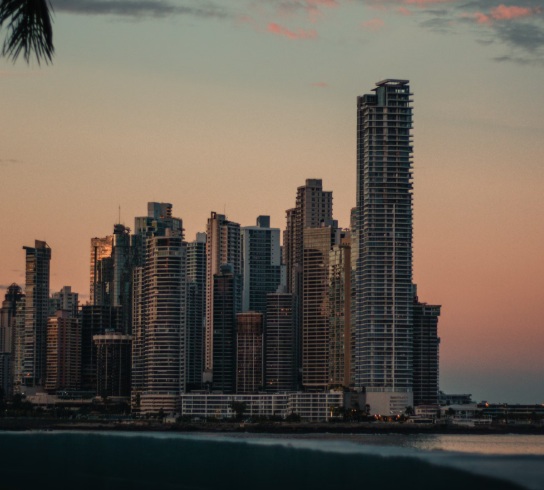
I know, all of this is pretty much day-dreaming, but the truth is that the wonderful pictures of Ave Balboa at night can’t cover the reality
of this once elegant avenue by day.