
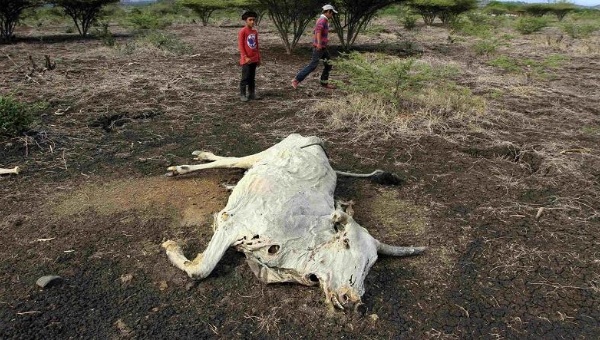
Worsening drought associated with the El Niño weather phenomenon has severely reduced crop output across Central America this season.
More drought is expected in Panama before the end of the year, experts said Sunday, adding to months of difficult conditions for farmers in the face of parched soils across Central America.
The climatology department at the Etesa electrical company called on Panamanians to exercise caution with water use during the upcoming dry spell to ensure reservoirs can continue to meet needs across the country, Cuban news agency Prensa Latina reported.
The company said that water conservation is the responsibility of everyone so that resources can be effectively shared.
The news comes as experts predict 2015 will be the hottest year on record.
But while parts of the country will continue to suffer drought, the particularly strong El Niño climatic effect this year means different parts of the region will be hit with different out-of-the-ordinary weather events. Areas along the Caribbean coast can expect heavier rainfall than usual in the early months of 2016, according to forecasts.
Worsening drought associated with the El Niño weather phenomenon has severely reduced crop output in Central America this fall for the second year in a row.
IN DEPTH: Latin America’s Fight for a Just Climate Solution
In Guatemala, Honduras, and El Salvador, all part of the Central American “dry corridor,” drought conditions have exacerbated already fragile food security. Historic drought in the Caribbean is also causing huge losses for farmers as the region suffers the driest conditions in more than five years.
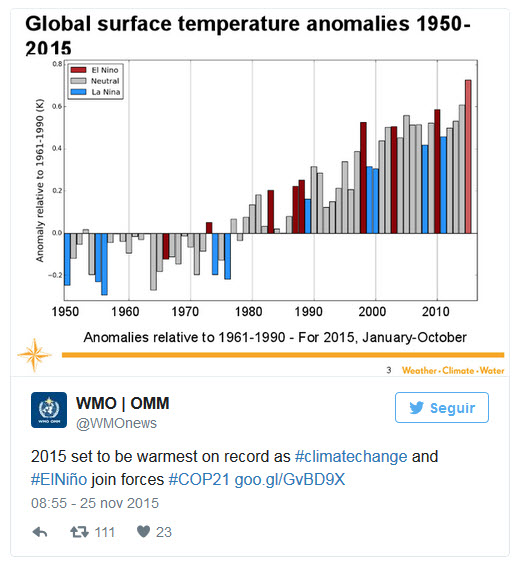
“2015, the hottest year in history.”
This year’s El Niño impacts in the region are worse than last year’s, according to the U.N. Food and Agriculture Organization.
According to scientists, extreme weather events including droughts, heat waves, and floods are expected to increase in frequency and intensity with climate change. Poorer nations in the global south are said to be the most vulnerable to the growing impacts of climate change.

The global temperature chart must be based on stats that are cherry picked and massaged to create a chart that shows man-made global warming is well underway.
I have seen other charts produced by more credible organizations that show there is no global warming over the past few years.
It’s always best to rely on common sense and verifiable evidence when it comes to something like global warming. In my case, I live 50 metres from the shoreline of the Pacific Ocean. If there was global warming as claimed by global warming believers, there would be a noticeable rise in sea levels and higher tides. I have been watching for this but there hasn’t been any change to the sea level or the tide over the past 25 years. None. Zero.
It seems that man-made global warming is just a new religion. Verfiable proof is not required if you have a religious belief like man-made global warming.