
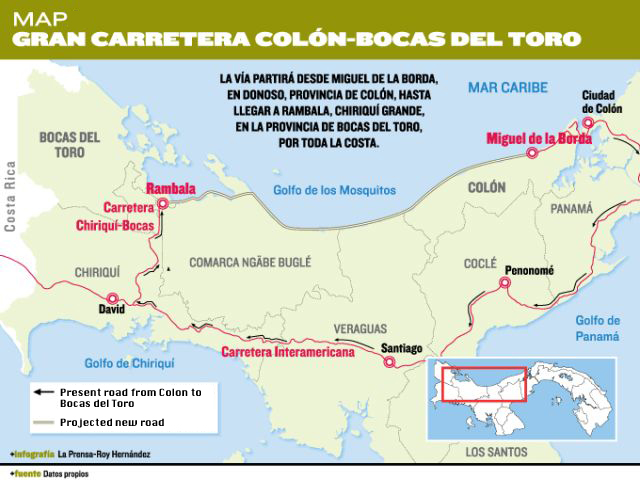
Another headline might be
Gran Carretera vs. Mesoamerican Biological Corridor
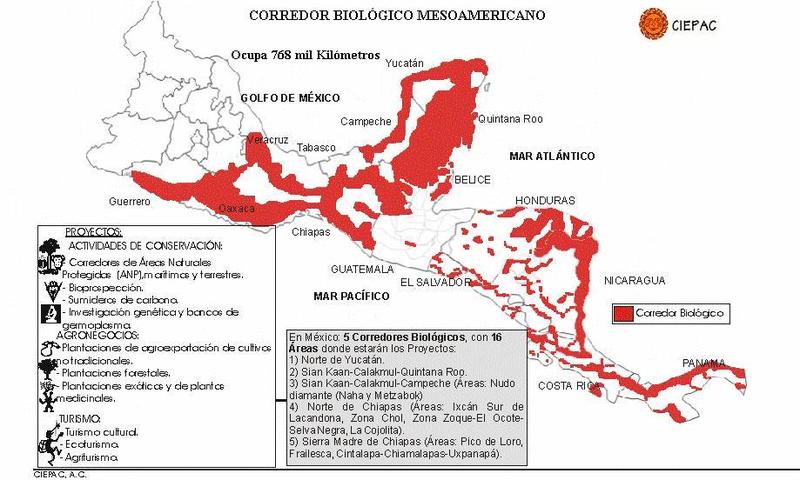
One needs to keep in mind the importance of protecting this fragile corridor that runs the length on Panama along the Atlantic coast before getting too excited about the development potential it opens up. This has been a proposal for 30 years now almost every year we hear that it will begin. Maybe it will become a reality but personally, I think that the $350 million could be better spent on the educational system here in Panama before we build anymore roads to promote building condos along the coastline. Anyway, here is the story as repeated many times over the years in La Prensa.
There may be plans in the works to build a road along Panama’s Atlantic coastline, but opponents wonder about the consequences on biological diversity.
The 143-mile coastal highway, denominated the Gran Carretera, would link the town of Miguel de la Borda in the province of Colon and Bocas del Toro’s Chiriqui Grande. At present, the only way to travel by road to Bocas del Toro is through the country along the Pan American Highway.
In 2008, Charles Ho, Director of the Ministry of Public Works’ Special Projects, estimated that the project would cost $350 million and would take three years to build.
Mario Miller, a Bocas del Toro deputy, said that the realization of this and other mega-projects will promote sustainable and integrated development that will define the present and future of Bocas del Toro. He added that $150 million has already been allocated towards project implementation.
Meanwhile, Alida Spadafora, Director of the National Association for the Conservation of Nature, made it clear that she is not opposed to the government’s plans to develop the coastal highway project, but asks that the Ministry of Public Works carefully and comprehensively analyzes the project before moving forward, including impact studies on climate change.
She argues that the opening of this route will have a direct impact on the Mesoamerican Biological Corridor, which runs from the Choco region in the Darien up to southern Mexico. A road of this type could affect the different mangrove and forest ecosystem of this biological corridor, she says.
For Jorge Pinto, President of the Society of Engineers and Architects’ Bocas chapter, the unnecessary road project, regardless of its economic benefits, will directly and negatively affect a considerable area of flora and fauna once work begins and more so when it is operative. He suggests fully rehabilitating the road Chiriqui-Bocas road instead.
And, then there are those who have not yet been consulted like the Ngöbe Bugle. Rogelio Moreno, chief general in absentia, said that the road will impact towns like Kusapín, Kankintú, Chiriqui, Ensenada and Santa Catalina, home to thousands of their brethren.
“We have not heard anything about it and we want them to see if the government intends to undertake this project which will affect the region,” the chief general in absentia said.
The road would bring a lot of economic gain to Panama. That is beautiful Caribbean beachfront. There is also huge agro-forestry potential which will help reverse climate change because managed agro-forestry will sequester a lot more carbon then the natural forest systems. Biological diversity there is no way around that being a negative impact. The encroachment of mankind is pretty much always a negative impact on wild untouched nature. But having been down that coast I know at this time it is being mowed down for cattle, road or no road. It is unmonitored and the locals that live there are making a living with unmanaged slash and burn. So while leaving it untouched is a nice idea on a certain level, that is not what is happening there and a road would allow better control and certain areas that could be designated parks and reserves while other areas of high value would be developed for maximum gain rather then the whole area going through a period of unmanaged slash and burn.
I have spent some time with the indigenous people and generally they embrace positive change. They are not particularly happy that their rights and payment for land taken from them is often not paid for. That the government will not listen to them or take the time to help them so that the change is positive for them. I have found most to be very industries people willing to work hard, willing, and capable of learning and growing with change if given the chance. I find it very sad that they have not been included on this as I think most would like it and embrace the positive things it could bring to the communities and they would be a positive and productive part of the communities that would be opened up. But when the government just tells them nothing, then lies to them and tries to steal the valuable land they have some of them upon seeing this get a bit pissed off. Hopefully they can get land titles and rights as well so they can gain and have positive growth from the project.
Over all I would say the road is a net positive thing. Even thought it has been talked about for 30 years the People of Panama have only been in charge of fully running the country for the last 14 years and a lot more is getting done now that they are in charge. Projects are being done at a very fast pace since they have taken over completely running the country and government. I would suspect this road gets built within the next 6 years. Land prices will go up by 500% and more as the road goes in. There is a very limited supply of titled land on that coast available, but when found there are great deals for fully titled beachfront land for under $10 per m2. On the west coast that same land would sell for $250 to $400 per m2. This is one of the best land bank opportunities in Panama for people with a 10 year investment horizon and some land management skills.