Screenshot
The Government of Panama, led by the Ministry of Commerce and Industries (MICI), is advancing a strategic agreement with the State of Arizona, United States. The agreement is to adopt best practices in microelectronics and attract technology companies to the country. This negotiation is complemented by the achievements. These already achieved in the training of skilled labor, the central axis of the National Semiconductor Strategy.
During the presentation organized by the Chamber of Headquarters of Multinational Companies. (CASEM), Tony Roldán, president of CASEM, presented the progress of the strategy to more than twenty multinational executives. Roldan highlighted Panama’s recent exit from the gray lists, considering it a key step to attract investments, especially in the semiconductor sector. He also highlighted the country’s efforts to join the OECD. Which will strengthen investor confidence by aligning Panama with international standards of transparency and development. In addition, he valued that the SEM regime offers a solid legal framework for companies in the sector.
At that event, it was reiterated that a group of Panamanians are already being trained at the University of Arizona. One of the leading institutions globally in this industry. In addition, a scholarship program for master’s and doctorates is promoted, with the commitment that the trained talent returns to the country to strengthen the national ecosystem.
In this context, the minister of MICI, Julio Moltó stressed that the preparation of human resources. That is the basis of the entire plan: “Beyond chips, this means real opportunities for our people, well-paid jobs and social mobility. Panama does not compete for volume, it competes for value,” he said.
For his part, Eduardo Ortega, secretary general of SENACYT. He explained that the agreement with Arizona will allow the incorporation of better practices and promote Panama to host international events related to the industry. “This is a great opportunity for Panama. What we have achieved in a short time demonstrates the capacity we have when we work organized and with vision,” Ortega said.
Academic contribution and business link
For her part, Elida de Obaldía, professor and researcher at the Technological University of Panama, highlighted the role of the C-TASC AIP Center. She highlighted to generate synergies and facilitate the country’s entry into high-potential market niches. In addition, he invited companies to join this strategy and participate in projects of the Human Development Committee. Stressing that technical training and innovation are essential to compete.
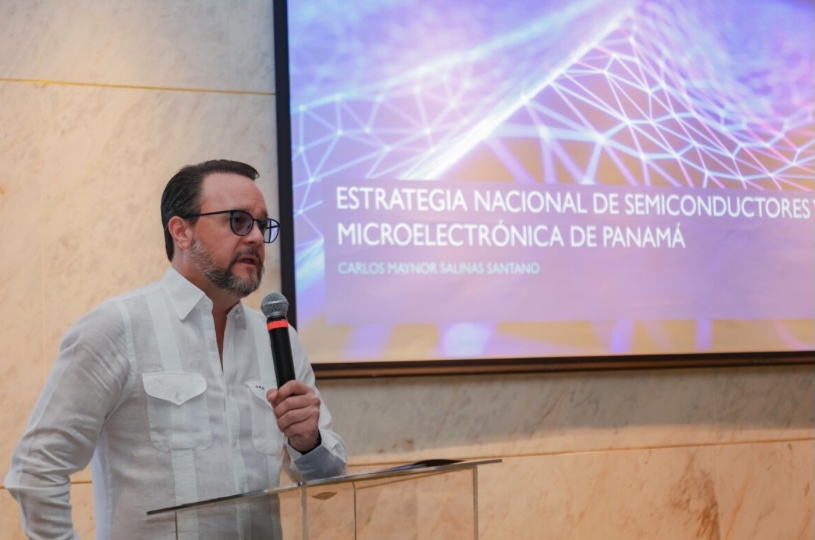
Carlos Maynor, SENACYT advisor, recalled the magnitude of the challenge: “This industry moves more than 6 billion dollars a year and Panama has what it needs to attract investment: connectivity, exit from gray lists, logistics infrastructure, special economic areas and first-level research centers.”
The National Semiconductor Strategy, designed with technical rigor and a vision of the State. This aims to transform the productive matrix, generate quality jobs and position Panama as a regional benchmark in advanced technology.
The MICI plays a central role in this initiative, chairing the Commission for Innovation in Microelectronics and Semiconductors (CIMS). The inter-institutional group responsible for developing this National Strategy.
About the Author