Screenshot
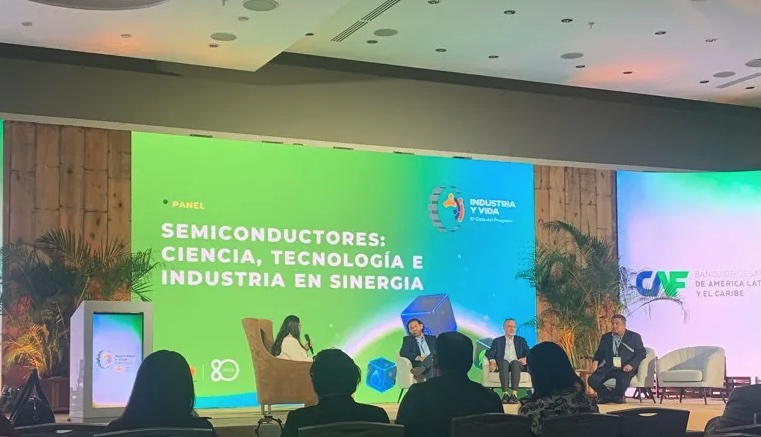
The panel Semiconductors: Science, Technology and Industry in Synergy, in the Industry and Life Forum: The cycle of progress, of the Union of Industrialists of Panama (SIP), addressed the challenges. The semiconductor industry has the potential to become a key engine of economic growth in Panama, by contributing significantly to the Gross Domestic Product (GDP), diversifying employment and enhancing the country’s technical and university educational system.
The figures, and expectations, blow with a headwind and it was the positive spirit that accompanied the recent panel Semiconductors: Science, Technology and Industry in Synergy, in the Industry and Life Forum: The cycle of progress, organized by the Union of Industrialians of Panama (SIP) on the occasion of its 80th anniversary.
Semiconductors is an issue that has managed to align in perfect harmony with the public, private and academic sector of Panama.
The Eng. Edgar Ivankovich, director of the SIP and who is also director of Corporate Affairs of AES Panama, told the media that “from the SIP we support from the beginning the project, its academic and capacity building component: it is crucial to have young people, who are also already preparing, and take on the challenges associated with the semiconductor industry.”
Consider that it is not only about encouraging the arrival of multinational companies. “The challenge will be to support the transfer of technology and knowledge.”
He considers that the country is doing well by encouraging training, attracting companies and launching a business that will be equivalent to “two or three times the contribution of the Panama Canal to the country.”
He pointed out that in addition to the specific area of semiconductors, young people who will return to the country, after their trained training, can join a competitive market and other industries in the area of applications in electronics or Artificial Intelligence.
As a member of the IAPA, he said that there is a commitment to the industry to strengthen the academy-company bond. In fact, through competitive funds from the Inter-American Development Bank (IDB), an agreement was established with the Tecnológico de Monterrey (TEC de Monterrey de México), to improve the technical capacities of those who will later join the Panamanian productive sector.
AES, for its part, also founded the AES chair in alliance with the Technological University of Panama (UTP), under a dynamic model: the professionals of the company talk to the young engineers and thus give them different tools, technical and soft skills, which strengthen their professional suitability and their abilities when inserting themselves into the business world. From the CHIPS Law to the new semiconductor map in Panama
During the panel Semiconductors: Science, Technology and Industry in Synergy of the IAPA, the master Carlos Maynor, advisor of the National Secretariat of Science, Technology and Innovation (Senacyt), Henry Kardonski, general manager of London & Regional Panama and Dr. Carlos Boya, academic researcher of the ITSE, under the moderation of theIng. Guadalupe González, by the UTP and the IEEE branch (Institute of Electrical and Electronic Engineers) of the UTP.
Carlos Maynor summarized a story that began on July 20, 2023.
On that date, the United States Department of State announced the partnership with Panama to explore opportunities with the aim of “increasing and diversifying the global semiconductor ecosystem, through the International Fund for Technological Security and Innovation (ITSI Fund), created by the CHIPS and Science Act of 2022.”
Although there have been changes in US policy, the synergy of the different sectors is maintained in Panama.
In August 2024, with the participation of 16 representatives of the public, private and academic sectors, the Commission for Innovation in Microelectronics and Semiconductors (CIMS) was installed, created in accordance with Executive Decree number 7 of April 30, 2024, which establishes its creation to promote the advancement and development of the semiconductor sector in the country, a priority for the government of President José Raúl Mulino.
Maynor reported that the strategy’s work plan was defined and Dr. Darío Solís was appointed as the national commissioner of the Semiconductor and Microelectronics Industry.
He stressed that governance is ready and a strategy with four central lines is being promoted:
- Train human talent and promote research and development
- Create the right business ecosystem to promote the sector
- Promote a relevant legal framework and guarantee infrastructure
- safety
On the other hand, he highlighted that the Technological University of Panama (UTP), the University of Panama (UP) and the ITSE, among other institutions, are promoting the training of their students, taking advantage of the offer of scholarships and specialized courses.
Senacyt has played a leading role in offering a wide range of doctorates, master’s degrees and stays.
With the industry, missions are being made as part of this collaborative ecosystem.
In fact, representatives of the National Commission for Innovation in Microelectronics and Semiconductors of Panama, led by the Minister of Commerce and Industries, Julio Moltó, and the national secretary of the National Secretariat of Science, Technology and Innovation (Senacyt), Dr. Eduardo Ortega Barría, were received in Jalisco, Mexico, on July 21 and 22 to carry out the “Panama-Jalisco Technological Mission: Semiconductors 2025”: Panama-Jalisco Technological Mission: Semiconductors 2025, alliances with the Silicon Valley of Latin America
In October, the country will be present in Arizona at a fair that will allow it to promote its actions and initiatives.
President Mulino announced the investment of $105 million to integrate into the semiconductor chain. It is a state policy that has transcended governments.
The Senacyt advisor, in an interview with the media, explained that the strategy consists not only of attracting companies but also of promoting the creation of business incubators, aimed at specific projects ranging from assembly, testing and packaging to providing inputs.
He pointed out that inserting into the global supply chain means, from Panama, serving large international markets. For example, the automotive or computer production industry.
The feasibility study contemplates establishing, in five years, with an investment of more than $1 billion, a company with the capacity to generate about 1,000 jobs, an idea based on a similar plant that Brazil has just installed in Arizona.
While this goal is met, it is projected that by the horizon of 2030 small factories will be established to accompany the process.
-How can the semiconductor industry impact the national GDP?
-In the case of Costa Rica, the semiconductor industry represents 2 or 3 points of GDP. If our projection is maintained, the contribution to GDP would be significant.
Henry Kardonski, general manager of London & Regional Panama, representing the private sector, said that work is being done to attract and create confidence in companies in the sector.
“We must continue to build that clear and responsible conversation between the academy, the productive sector and the State.”
He highlighted the efficiency of Panama’s logistics system, its ports, airports and communication systems.
He said that Panama has all the attributes when compared to big competitors such as Mexico, Costa Rica and the Dominican Republic.
He announced that ten companies have visited Panama and shown interest in making short-term investments.
Specifically, Japan, the United States and Argentina are interested in starting to work in Panama as the axis of the global semiconductor industry.
Dr. Carlos Boya highlighted the value of technical education in this process. “Without technical education there is no semiconductor industry because it requires people with high capabilities who are present in the processing chain and do diagnosis and repair.”
He said that the ITSE is preparing the staff. On the country side, it is necessary to create conditions for young people to return from their preparation and to get real opportunities to fit in and contribute.
About the Author