Screenshot
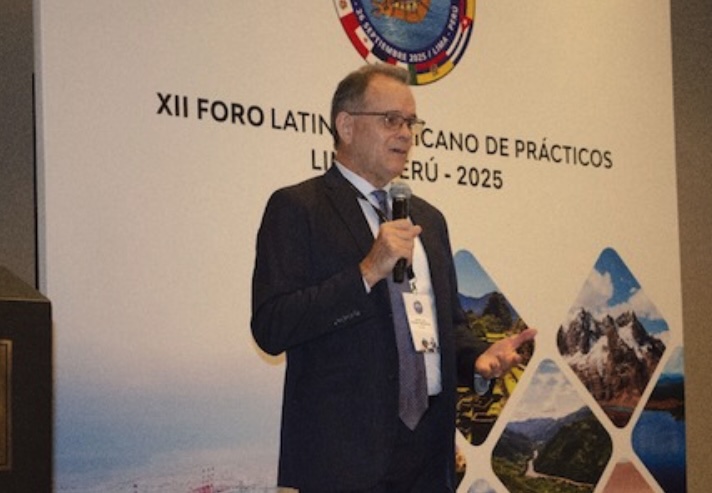
At the Latin American Practitioners Forum held in Lima, the delegation of the Association of Practitioners of the Panama Canal (APCP) presented the role of the Canal as a world reference in safe operations and in the management of water resources with impact for millions of people.
Captain Álvaro Moreno, member of the Board of Directors of the APCP and senior vice president of IMPA, said that the experience of the Panama Canal has contributed to strengthening international maritime security, establishing standards of efficiency and reliability for global navigation.
Moreno highlighted the Río Indio Project, a strategic initiative that seeks to expand the water storage capacity in the Canal basin. He explained that this work would benefit both the transit of ships and the supply of drinking water for about two million people in the cities of Panama and Colón, thanks to the current operation of eight drinking water plants in Lake Gatún and plans to open more plants in the coming years.
The Forum was also a stage to discuss the permanent risks to which practitioners and seafarers are exposed, underlining the need to strengthen safety measures during embarkation and disembarkation, as well as cooperation between unions to consolidate a safer, more efficient and competitive maritime sector.
The Panamanian delegation highlighted that the experience of the Canal, with more than a century of world-class operations and standards, continues to be a living laboratory for the best navigation practices, and that the future of the sector requires innovation, sustainability and trained talent.
About the Author