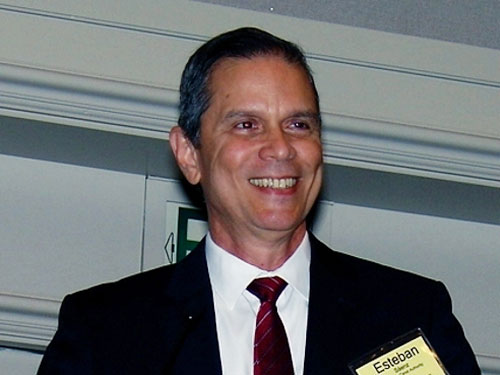
Esteban G. Sáenz, in one of his final duties as VP for transit business for the Panama Canal Authority, speaks ebulliently at the AAPA Planning for Shifting Trade Conference. (Photo by Paul Scott Abbott, AJOT)
The recent Panama Canal expansion project is delivering better-than-anticipated benefits, according to an official with a third of a century of experience with the Central American isthmus waterway.
The third set of locks opened in mid-2016 has proven so advantageous that a fourth new set is being contemplated and other additional infrastructure is already being developed, according to Esteban G. Sáenz, who held the position of vice president for transit business at the Panama Canal Authority when he spoke at an American Association of Port Authorities conference in Tampa, FL.
We’re doing much better than we expected,” Sáenz said Jan. 31, before retiring the following week after having worked at the Panama Canal since coming aboard as a civil and hydraulics engineer in 1985.
Total tonnage passing through the Panama Canal, as measured by toll assessment levels, is projected to be “very close” to 500 million in the fiscal year to end Sept. 30, 2020, Sáenz said, with traffic in the current fiscal year also anticipated to significantly exceed original prognostications. Traffic in the fiscal year ended Sept. 30, 2018, reached a record 441 million Panama Canal tonnage units.
On a typical day, Sáenz said, eight vessels, primarily megacontainerships, pass through the newest locks, while between 25 and 30 ships transit the older, smaller locks, but Panama Canal Authority income between the two passage options comes out to about a 50-50 split.
Over the past 2 1/2 years, the transit time through the large new locks has been reduced to 2 1/2 hours from 3 1/2 hours, and, as Sáenz noted, “We are improving every day.”
Whereas the CMA CGM Theodore Roosevelt, with a capacity of 14,863 twenty-foot-equivalent container units, which transited the new locks in August 2017, remains the largest containership to go through the Panama Canal, Sáenz said shipbuilders are working on vessels with capacities of more than 15,000 TEUs that have dimensions allowing them to transit the new locks.
And Panamanian officials are studying construction of yet another set of locks capable of accommodating still-larger ships, according to Sáenz, who commented, “We are already thinking about a fourth set of locks in years to come.”
As was the case back in 1914 when the original Panama Canal opened for business, the United States remains the No. 1 user of the waterway, with more than two-thirds of current transits beginning or ending at a U.S. port, Sáenz said. It is followed on that list by China, Chile, Mexico (propelled by Mexican exports of liquefied natural gas) and Japan. Sáenz said he anticipates that, by 2020, the number of LNG vessels going through the canal on a typical day will double to two from the current one. The greatest share of Panama Canal Authority income comes from container vessels heading from Northeast Asia to the U.S. East Coast.
The Panama Canal’s worth goes beyond facilitating passage of ships between Pacific and Atlantic oceans, according to Sáenz.
“The canal is all about reliability, connectivity and value-added services,” Sáenz.said, citing plans for adding to the container and roll-on-roll-off cargo terminals already in place at either end of the waterway, as well as an LNG terminal under study for the Pacific side, logistics park development, facilities for generation of electric power, and bunkering and pipeline installations. A third bridge across the canal is on target for completion by mid-2019.

Paul Scott Abbott
About the Author